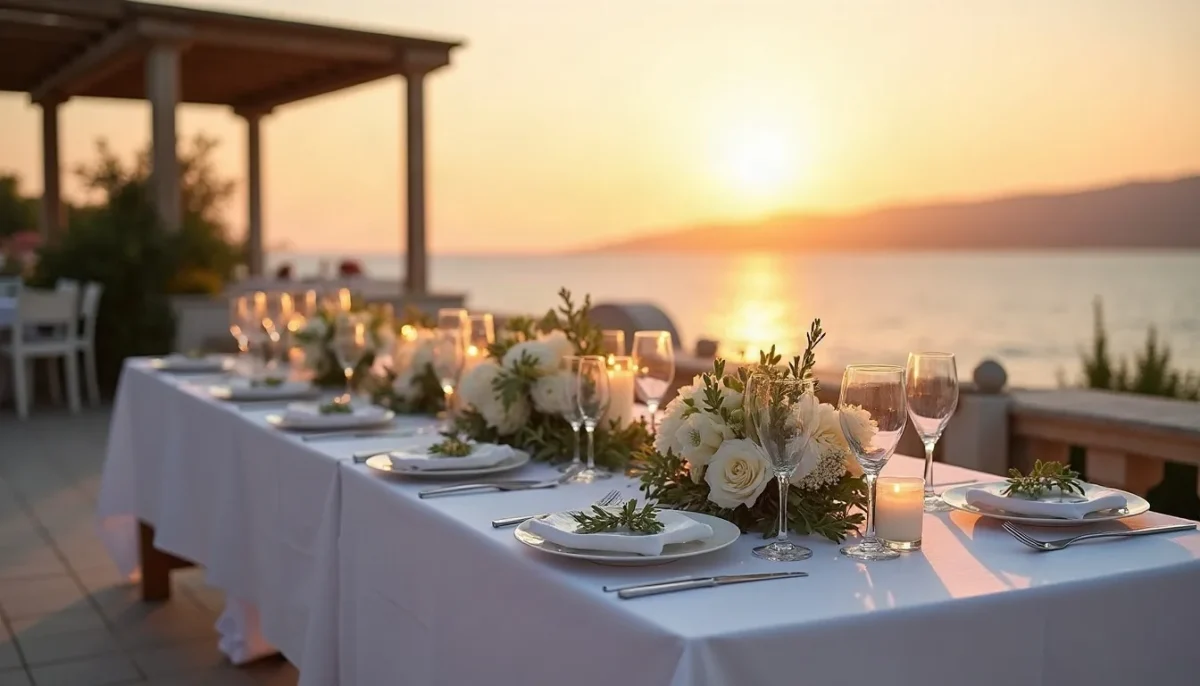
Athens gives couples an unusual choice for a single city: a reception with the Acropolis on the skyline, a ceremony on the sand, or a celebration on the water a short ride from the centre. Each setting brings its own logistics, and the venue you pick will shape your timing, your guest transport and the feel of the evening. Here are the main types of venue and the questions worth asking before you sign anything.
Start with the guest list, not the view
Capacity is the first filter. A rooftop in the historic centre can feel generous for a cocktail reception and tight for a seated dinner with a dance floor, while a large waterfront space may feel empty with a few dozen guests. Ask each venue for its capacity standing, seated and in ceremony rows, and check how much of that space is covered. Include musicians, photographers and catering staff in your count, as they all take up room.
Decide early whether the ceremony and reception happen in the same place. One venue saves a transfer and gives you more time with your guests. Splitting them can work beautifully, but every move adds coaches, timing buffers and a chance of delay.
City rooftops with Acropolis views
Rooftop venues in central Athens are chosen for the skyline. The Acropolis rising above the city gives an evening reception a sense of place that is hard to match. Rooftops suit an urban celebration after dark, guests staying in central hotels and weddings of small to medium size.
The trade-offs are space and weather. Ask what happens if wind or a late shower moves part of the evening indoors, whether the enclosed area fits everyone and how late music can run. Check where coaches and taxis can stop, and how far guests will walk from there.
The Athens Riviera: beach and seafront venues
South of the city, the Athens Riviera offers sand, sea and sunsets within reach of the centre. Its beaches start close to Piraeus and continue to Cape Sounio, with Glyfada about 14 km from the centre, Vouliagmeni about 23 km and Lagonisi about 34 km. That range matters: a venue in the nearer suburbs is a short transfer, while one further down the coast is a real journey for guests coming from city hotels.
Beach venues work best for a ceremony in the last hour of daylight, with dinner as the light fades. Ask about shade, wind, the surface guests will walk on in formal shoes and whether the beach stays private during your event. The coast road can also get busy in summer, so allow extra time for transfers at peak hours.
Marinas and floating venues
Between the city and the beaches, the Faliro waterfront offers marinas, yachts and open water rather than sand. A marina clubhouse suits a smaller gathering such as a welcome evening, while a floating venue can host a full wedding with the sea on every side.
On the water, ask about access for older guests, the weather plan, separate areas for ceremony, dinner and dancing, and the rules on decoration and candles. Being close to the centre is the big advantage, since the Faliro coast is linked to central Athens by tram. To compare these settings side by side, a curated selection of wedding venues in Athens brings together a 240 sq.m. rooftop in Monastiraki facing the Acropolis, a beach bar at Lagonisi on the Athens Riviera, a private clubhouse at Flisvos Marina and a 1,500 sq.m. floating venue on three levels in Palaio Faliro.
Timing: season, heat and daylight
Athens has long, dry summers. Long-term climate records for central Athens (1961-1990) show average daily highs of about 30°C in June and 32-33°C in July and August, with around two rainy days a month in midsummer. May and September are milder, at roughly 25°C and 29°C, while October averages about 23°C and nine rainy days. These are averages, not forecasts.
For an outdoor wedding in high summer, start the ceremony in the early evening, offer shade and water during welcome drinks and keep speeches short until the heat breaks. Spring and early autumn are gentler for daytime events, but keep a covered plan B ready, especially from October onwards.
Getting guests there and home
Most international guests will land at Athens International Airport, which is linked to the city centre and Piraeus by metro line 3 and by express buses to Syntagma (X95), Piraeus (X96) and Elliniko metro station (X97). The airport estimates about 60 minutes to Piraeus by metro and about 90 minutes by the X96 bus, so a seaside venue can be much closer to some hotels than to others.
In the city, the tram connects central Athens with the coastal suburbs of Faliro, Voula and Piraeus and runs from 5:30 am to midnight, while the metro runs from 5 am to midnight. A wedding that ends after midnight needs its own plan: book coaches for the return trip, share the schedule with guests in advance and agree a clear pick-up point with the venue.
Questions to ask before you book
- What is the seated capacity, and how much of the space is covered?
- What is the plan for wind or rain, and is it included in the price?
- Until what time can music play, and do late hours cost extra?
- Is catering in-house, or can you bring your own?
- Is the venue exclusive to your event?
The right venue is the one that fits your guest list, your season and the way you want the evening to feel. Visit at the same time of day as your event if you can, watch where the sun sets and time the journey from your guests’ hotels. Those small checks turn a beautiful view into a day that runs smoothly.
Sources
- National Observatory of Athens, Climatological Means. https://www.iersd.noa.gr/ENG/iersd_climat-table.htm
- Discover Greece, 12 of the best beaches on the Athens Riviera. https://www.discovergreece.com/travel-ideas/cover-story/discover-12-best-beaches-athens-riviera
- Athens International Airport, Public transportation. https://www.aia.gr/en/traveller/transportation-airport/public-transportation-airport
- This is Athens, Public Transport. https://www.thisisathens.org/getting-around/public-transportation-metro-bus-tram
Διαβάστε επίσης
 ΕκδηλώσειςΆνετο χτένισμα για το παρανυφάκι από την εκκλησία ως τη δεξίωσηΠρακτικές συμβουλές για γονείς ώστε το χτένισμα του παρανυφακιού να κρατήσει όλη τη μέρα χωρίς να σφίγγει και χωρίς δάκρυα.11/11/2026 · 4 λεπτά ανάγνωσης
 ΕκδηλώσειςΤα χρώματα της Johnnie Walker: από το Red Label στο BlueΤα χρώματα στις ετικέτες της Johnnie Walker δεν είναι διακόσμηση. Δείτε τι ξεχωρίζει κάθε blend της σειράς και τι σημαίνουν τα έτη στη φιάλη.5/11/2026 · 6 λεπτά ανάγνωσης
 ΕκδηλώσειςΧώροι εκδηλώσεων στην Αθήνα: τι να συγκρίνετε πριν κλείσετεΈνας πρακτικός οδηγός για να συγκρίνετε χώρους εκδηλώσεων στην Αθήνα για γενέθλια, επέτειο, αρραβώνα ή γλέντι. Κλειστός ή ανοιχτός χώρος, εποχή, πρόσβαση και τι να ζητήσετε στην προσφορά.29/10/2026 · 5 λεπτά ανάγνωσης
Κάτι δεν στέκει;
Αν κάποιο στοιχείο έχει αλλάξει ή είναι ανακριβές, στείλτε μας τη διόρθωση και θα ενημερώσουμε το κείμενο.