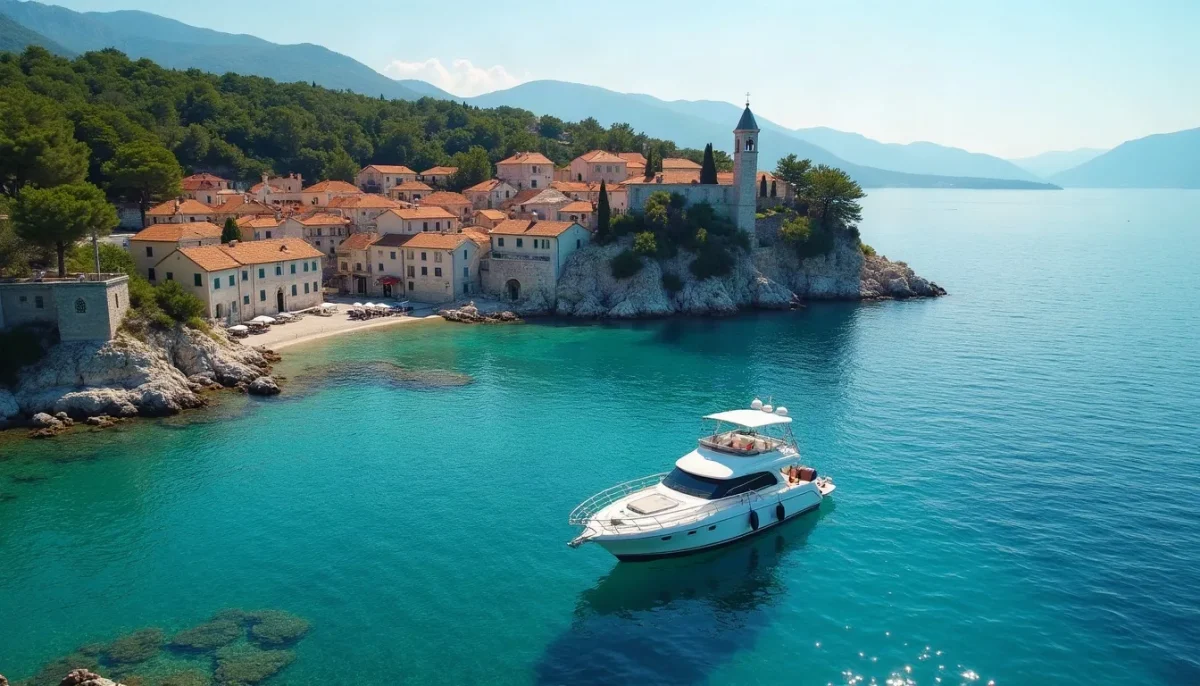
The stretch of Adriatic coast between Split and Dubrovnik is one of the most rewarding places in Europe to travel by sea. Islands lie close together, harbours are short hops apart, and each stop has its own character – a Venetian square, a fortified old town, a national park with saltwater lakes. This guide walks through the route island by island, so you can see what each one offers before choosing how to sail it.
Why Dalmatia suits island hopping
Central and southern Dalmatia is a chain of long, narrow islands running parallel to the mainland. Brač and Hvar sit just off Split, Korčula and Mljet lie further south towards Dubrovnik, and the distances between them are short enough that a boat can reach a new harbour every day without long stretches at sea. That rhythm – a morning sail, an afternoon ashore, an evening in port – is what makes the region so well suited to a week on the water.
The route also links some of the most important heritage sites on the Adriatic. Trogir, a short distance from Split, and the old city of Dubrovnik are both inscribed on UNESCO’s World Heritage List, and so is the Stari Grad Plain on Hvar. Few coastlines put this much history within a single week’s sailing.
Trogir and Split – where many routes begin
Trogir is an island settlement whose grid of streets dates back to the Hellenistic period. Over the centuries its rulers added public buildings, private palaces and fortifications, so a short walk takes you past Romanesque churches and Renaissance and Baroque buildings from the Venetian era. UNESCO describes it as a remarkable example of urban continuity. For travellers starting in central Dalmatia, Trogir and nearby Split are the natural gateways to the islands.
Brač and the beach at Bol
Brač is the island closest to Split, and its best-known landmark is Zlatni Rat beach at Bol, on the island’s open southern shore. The Split-Dalmatia County Tourist Board describes it as a pebble beach formed by fine gravel collecting around a submerged reef, so that it reaches into the sea like a tongue. It is around 500 metres long, and its tip shifts with the winds, waves and currents. The windy channel between Brač and Hvar has also made Bol a favourite spot for windsurfers. Bol itself began as a community of winegrowers, fishermen and sailors.
Hvar – a Venetian square and a Greek field system
Hvar town is built around St Stephen’s Square, which the Hvar Tourist Board calls the largest square in Dalmatia, at about 4,500 square metres. It was once a deep cove. Around it stand St Stephen’s Cathedral, built between the 16th and 18th centuries, and the Arsenal of 1579, which once serviced Venetian ships and now houses what the tourist board describes as the oldest communal theatre in Europe. Above the town, the Fortica fortress sits on a hill about 100 metres high.
On the other side of the island lies the Stari Grad Plain, a cultural landscape colonised by Ionian Greeks from Paros in the 4th century BC. According to UNESCO, the same main crops – grapes and olives – are still grown there today, which makes the plain a rare living link to the ancient Greek world.
Korčula – an old town and a sword dance
Further south, Korčula is known for its compact old town and for the Moreška, a sword dance that the Korčula Tourist Board calls a cultural symbol of the island. Performed by local men who are both dancers and swordsmen, it tells the story of a battle between two kings and has been danced on Korčula for over 400 years. The tourist board notes that Korčula is the only place where it has survived, with regular summer performances, mainly in the town of Korčula.
Because the islands are so close together, a Croatia island hopping cruise on a small ship can combine Hvar, Korčula and Vis with quieter harbours that larger vessels cannot reach. On thevivestia.com, the Croatian itineraries run for 7 nights between Trogir, Split and Dubrovnik on small motor yachts that carry no more than 42 guests, and each ship can be explored through a 360° virtual tour before booking.
Mljet – the national park near Dubrovnik
Mljet is the greenest stop on the route. Its national park, founded on 11 November 1960, is described by the park authority as the oldest marine protected area in the Mediterranean. It covers almost 5,300 hectares – nearly a third of the island – including a marine strip, islets and cliffs. At its heart are two deep bays filled with seawater, Malo Jezero and Veliko Jezero, and on the small island of St Mary in the Great Lake stands a Benedictine monastery, the park’s most visited site. Boats usually land at Polače and Pomena, and footpaths lead from there to the lakes, with options for swimming, canoeing and hiking.
Dubrovnik – the end of the line
Most routes south finish in Dubrovnik, the city often called the Pearl of the Adriatic. From the 13th century it grew into a significant Mediterranean sea power. A severe earthquake struck in 1667 and the city was damaged again in the armed conflict of the 1990s, yet it kept many of its Gothic, Renaissance and Baroque churches, monasteries, palaces and fountains. Sailing in, with the walls rising from the sea, is a fitting way to end a Split to Dubrovnik cruise.
Planning your route
- Direction: routes run both north to south and south to north, so check whether your trip starts in Trogir, Split or Dubrovnik when booking flights.
- Time ashore: Hvar town, Korčula and Dubrovnik reward a full afternoon on foot; Mljet is best for a walk or swim around the lakes.
- Timing: if seeing the Moreška matters to you, look for a sailing date in the summer performance season.
- Ship size: smaller vessels can moor in small harbours and quiet bays, which shapes how much of each island you see.
Whichever direction you choose, the islands between Split and Dubrovnik pack Greek fields, Venetian squares, a 400-year-old dance and a marine national park into a single week at sea.
Sources
- UNESCO World Heritage Centre, Stari Grad Plain. https://whc.unesco.org/en/list/1240
- UNESCO World Heritage Centre, Historic City of Trogir (UNESCO/NHK). https://whc.unesco.org/en/documents/122142
- UNESCO World Heritage Centre, Old City of Dubrovnik (UNESCO/NHK). https://whc.unesco.org/en/documents/103986/
- Mljet National Park, About the park. https://np-mljet.hr/about-the-park/?lang=en
- Tourist Board of Split-Dalmatia County, Bol. https://www.dalmatia.hr/destination/bol/
- Hvar Tourist Board, A walk full of culture. https://visithvar.hr/a-walk-full-of-culture/
- Korčula Tourist Board, The Sword Dance of Moreška – a proud tradition of Korčula. https://visitkorcula.eu/en/cultural-heritage/the-sword-dance-of-moreska/
Διαβάστε επίσης
 ΤαξίδιαWhat the PDO Label Tells You About Peloponnese FoodKalamata olive oil, sfela, Tsakoniki eggplant and Mantinia wine all carry an EU protected name. Here is what PDO and PGI mean and where these Peloponnese foods come from.22/10/2026 · 6 λεπτά ανάγνωσης
 ΤαξίδιαSailing the Ionian Islands: Winds, Bases and a 7-Day LoopHow the summer maistros shapes a sailing day in the Ionian, which base suits which islands, and a sample seven-day loop from Lefkas, plus the protected waters around Zakynthos.21/10/2026 · 6 λεπτά ανάγνωσης
 ΣπίτιΝεροχύτης κουζίνας: υλικό, τοποθέτηση, γούρνες και μπαταρίαΠώς διαλέγουμε νεροχύτη κουζίνας: ανοξείδωτος, συνθετικός γρανίτης ή κεραμικός, ένθετος ή υποκαθήμενος, πόσες γούρνες και ποια μπαταρία ταιριάζει.5/11/2026 · 5 λεπτά ανάγνωσης
Κάτι δεν στέκει;
Αν κάποιο στοιχείο έχει αλλάξει ή είναι ανακριβές, στείλτε μας τη διόρθωση και θα ενημερώσουμε το κείμενο.