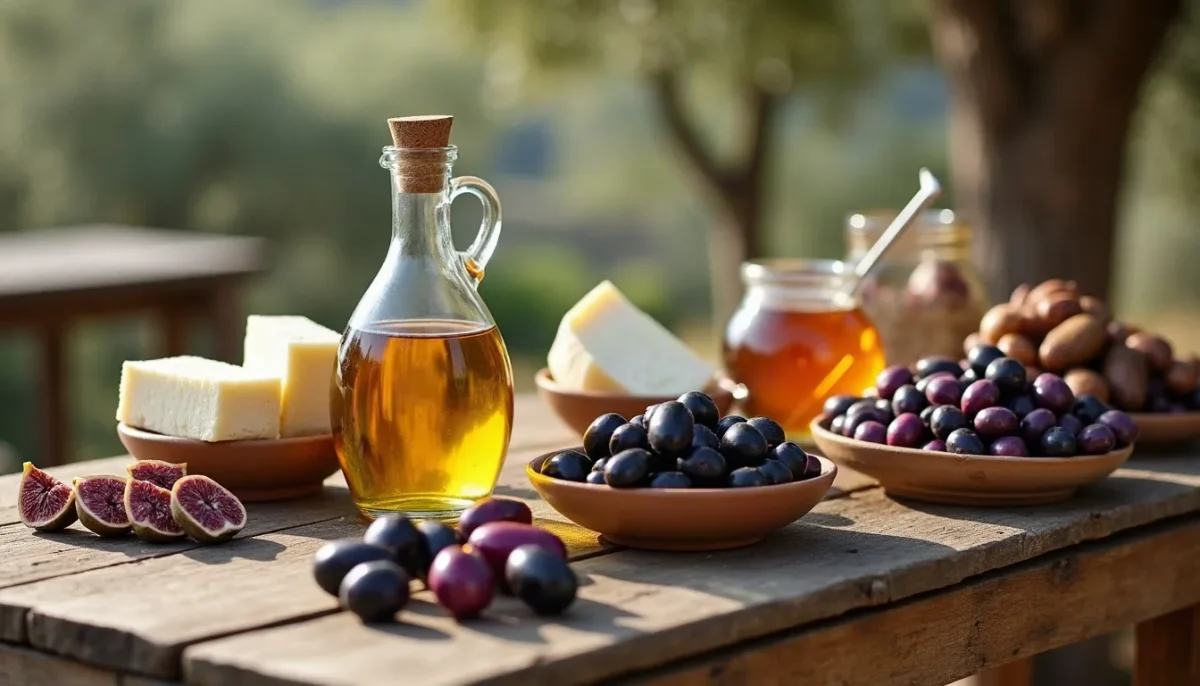
Ask anyone who has spent a summer in the southern Greek mainland what they brought home, and the answer is often edible: a tin of olive oil, a jar of olives, a wedge of cheese wrapped twice against the heat. The Peloponnese is home to a long list of local products, and several of them carry an EU protected name that ties them to a specific place.
Those small seals on a label are more than decoration. Knowing what they mean makes it easier to shop at a village market, to read a menu and to understand where a product really comes from. Here is a practical guide to the protected foods of the region, what the labels promise and when to see them being made.
What PDO and PGI actually mean
The European Union runs two main schemes for food linked to a place. A Protected Designation of Origin (PDO) is the stricter one: every part of the production, processing and preparation has to take place in the defined region. For wine, a PDO means the grapes come exclusively from the area where the wine is made.
A Protected Geographical Indication (PGI) is looser. For most products, at least one stage of production, processing or preparation takes place in the region, and for wine at least 85% of the grapes must come from that area. On food and agricultural products the EU logo is mandatory, while on wine it is optional, so a bottle can be protected without showing the symbol.
Olive oil, table olives and sfela from Messinia
Messinia, in the southwest of the Peloponnese, is olive country. Its olive oil, made mostly from the Koroneiki variety, has been protected as PDO Kalamata since 1997, and around 95% of the oil produced in Messinia is extra virgin. The region is just as well known for its table olives, made from the Kalamon variety, the familiar Kalamata olive. Most of them are preserved in brine, and they are PDO-protected as well.
The other Messinian name worth learning is sfela. This brined white cheese is related to feta but spicier and saltier, and it has been a PDO product since 1996. It is produced only in Messinia and neighbouring Laconia, from the pasteurised milk of goats and sheep grazing in those areas, and it needs at least three months to mature. The name comes from the way the curd is cut, since sfela means strip. You will find it in shops selling traditional products and on restaurant tables, in salads and pies.
Not every local favourite carries a seal. Messinian figs, eaten fresh in summer or turned into jams, spoon sweets and fig paste, and pasto, pork that is salted and smoked and served as a meze with cheese or spirits, are part of everyday eating without a label to prove it. If you want to see how these ingredients turn into actual dishes, from cured pork and crispy lalagia to grape must pudding, this overview of Peloponnese food walks through the specialties worth ordering.
Eggplant, fir honey and Mantinia wine in Arcadia
Further east, Arcadia counts three PDO products. The first is the Tsakoniki eggplant, grown in Tsakonia around Leonidio, where it ends up in local dishes such as eggplants baked with feta and on the tables of the Leonidio festival. The second is the wine of Mantinia, a zone where Moschofilero makes up 85% of the grapes and the harvest comes late, in October.
The third is the white fir honey from the slopes of Mount Mainalo, a PDO product known for the fact that it does not crystallise. Arcadia also has well-loved products without a protected name, such as its chestnuts, celebrated at festivals in Kastanitsa, Kosmas and Ano Doliana, and the gruyere of Tripoli.
Wine and raisins from Nemea to Monemvasia
Wine is where Peloponnese labels get most interesting. In Nemea, the PDO Agiorgitiko produces velvety red wines. In the south, Monemvasia was historically famous for sweet Malvasia, a wine that has been revived and given PDO status. Around Patras, Roditis is also PDO-protected, while Messinia has the PGI wine names Trifilia, Pylia and Messinia.
Then there is the Corinthian currant, the small dried grape known as Greece’s “black gold” in the 19th century. Of the raisins produced in the region, the PDO Vostitsa raisin is considered the highest quality. Travel through the hills in August and you will see raisins drying on the threshing floors, and in Messinia the sweet, seedless Corinthian grapes laid out under the sun.
How to shop and when to go
- On packaged food, look for the PDO or PGI name together with the EU logo. On wine, read the label for the protected name, because the logo itself is optional.
- Visit Messinia in autumn if you want to see olive oil being made. The olive harvest there brings families and friends together every year.
- For wine, autumn is also the time to go. Mantinia harvests in October, and the Messinia Terroirs Wine Festival takes place each autumn.
- In late summer, August is the month of drying raisins, and oregano blooms on Mount Taygetos in late summer and autumn.
Some places on the coast open the harvest to visitors. In Petrochori, near Voidokilia beach, Ammothines, a restaurant, beach bar and glamping site built on a dune complex, offers olive and grape harvesting, cooking lessons and private meals with live cooking, recommended from late August to early November.
A label is a starting point
Protected names do not cover everything good on a Peloponnese table, and some of the best things you will eat there carry no label at all. What they do give you is a reliable short list: foods that are made in the place their name promises, from the olive groves of Messinia to the vineyards of Nemea and the fir forests of Arcadia. Start with those, then let the local markets and menus fill in the rest.
Sources
- European Commission, Geographical indications and quality schemes explained. https://agriculture.ec.europa.eu/farming/geographical-indications-and-quality-schemes/geographical-indications-and-quality-schemes-explained_en
- Discover Greece, The Messinian diet: Local products that offer a timeless taste of the Peloponnese. https://www.discovergreece.com/travel-ideas/cover-story/messinian-diet-local-products-offer-timeless-taste-peloponnese
- Discover Greece, A foodie guide to the Peloponnese. https://www.discovergreece.com/travel-ideas/cover-story/foodie-guide-peloponnese
- Visit Peloponnese, Sfela. https://www.visitpeloponnese.com/en/prdct/sfela
- Visit Peloponnese, Gastronomy and local products of Arcadia. https://visitpeloponnese.com/en/prdct/gastronomy-and-local-products-arcadia
Διαβάστε επίσης
 ΤαξίδιαSailing the Ionian Islands: Winds, Bases and a 7-Day LoopHow the summer maistros shapes a sailing day in the Ionian, which base suits which islands, and a sample seven-day loop from Lefkas, plus the protected waters around Zakynthos.21/10/2026 · 6 λεπτά ανάγνωσης
 ΥγείαΟι πρώτες εβδομάδες μετά την ογκεκτομή μαστούΤι γίνεται την ημέρα της ογκεκτομής και τις εβδομάδες που ακολουθούν: παροχέτευση, ντους, οδήγηση, δουλειά, αναμενόμενες αλλαγές και τα επόμενα βήματα μετά τα αποτελέσματα.22/10/2026 · 5 λεπτά ανάγνωσης
 ΥγείαΜετά την απονεύρωση: οι πρώτες μέρες και το βήμα που μένειΕυαισθησία, μάσηση και προσωρινό σφράγισμα: τι περιγράφουν οι αξιόπιστοι φορείς για τις μέρες μετά την απονεύρωση και γιατί η μόνιμη αποκατάσταση δεν πρέπει να αργήσει.22/10/2026 · 5 λεπτά ανάγνωσης
Κάτι δεν στέκει;
Αν κάποιο στοιχείο έχει αλλάξει ή είναι ανακριβές, στείλτε μας τη διόρθωση και θα ενημερώσουμε το κείμενο.