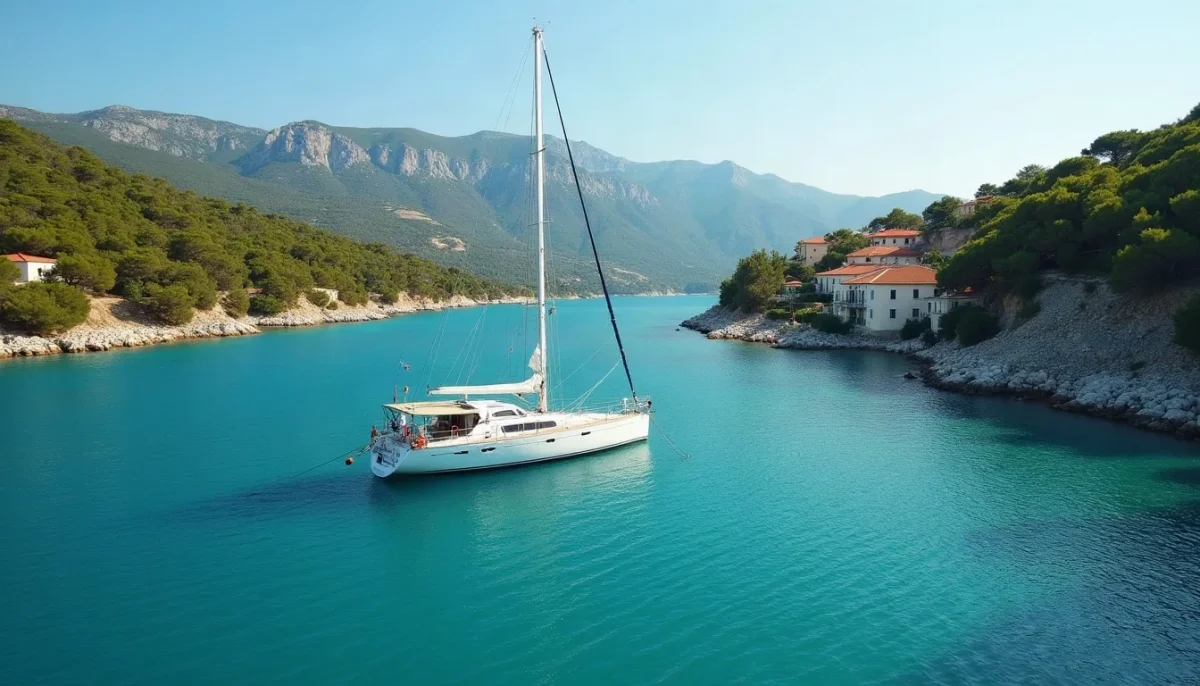
Strung in a chain down the west coast of Greece, the Ionian Islands are green, closely spaced and full of sheltered bays, which makes this one of the most relaxing stretches of coast in Greece to sail. That geography shapes how a sailing week works here: the summer wind follows a fairly predictable daily rhythm, the larger islands protect the water to their east, and the right base can keep long open-sea legs to a minimum. Here is how to plan around it.
How the island chain shapes a sailing week
The main group is usually given as Corfu, Paxos, Lefkada, Kefalonia, Ithaca and Zakynthos, with Kythera often counted as a seventh. Between the larger islands sit smaller ones such as Meganisi, Kalamos, Kastos and Antipaxos, and together they keep most daily passages short.
Lefkada and Kefalonia also work as a natural breakwater. They limit the stretch of open water that the wind can blow across to their east, so the channels and bays on the mainland side tend to stay calmer than the outer coasts. Their mountains, however, can funnel the wind along certain coastlines.
Reading the daily wind cycle
In summer the prevailing wind is the north-westerly maistros, often called the maestro. It is a thermal wind, driven by the temperature difference between the relatively cool sea and the heated mainland, and it follows a daily cycle you can plan around:
- Morning: the sea is usually flat, a good window to leave a busy quay under engine.
- From around 13:00: the breeze starts to build.
- Afternoon: it typically settles at around 3 to 5 Beaufort.
- Sunset: the temperature difference fades, the wind drops quickly and anchorages are usually quiet at night.
Two local details are worth knowing. Off Vasiliki on the south coast of Lefkada, a local wind can come down from the mountains in the early afternoon and rise from calm to about 6 Beaufort within minutes. And when you moor in the afternoon, a gust on the beam can push the bow off quickly, so have lines and fenders ready before the approach. Thunderstorms can occur, especially at the end of summer, and in October the summer pattern breaks down, bringing southerly winds, swell and local storms that call for flexible plans.
Choosing a base: north, centre or south
Where you start decides which part of the chain you can explore comfortably in a week. Routes are usually grouped around three areas:
- Corfu (Gouvia): a northern base for Paxos, Antipaxos, Sivota and Parga. Corfu’s Old Town has been a UNESCO World Heritage Site since 2007, and its three forts, designed by Venetian engineers, protected maritime trade for about four centuries.
- Lefkada and Preveza: the gateway to the sheltered “Inland Sea”, with Meganisi, Kalamos, Ithaca and Kefalonia within reach.
- Kefalonia and Zakynthos: starting points for the southern Ionian.
Airports matter for your first and last day too. Corfu (CFU), Aktion/Preveza (PVK), Kefalonia (EFL) and Zakynthos (ZTH) all serve the region. If you are comparing options for an Ionian yacht charter, Astra Yachting lists departures from Corfu, Lefkada, Preveza and Zakynthos, with sailing yachts, catamarans and luxury crewed yachts, and checks availability live before sending a written quotation.
A sample seven-day loop from Lefkas
One week-long loop that starts and finishes in Lefkas runs like this:
- Day 1: Lefkas to Meganisi, with a stop in Spilia bay.
- Day 2: Meganisi to Kalamos and its quiet harbour.
- Day 3: Kalamos to Kastos, a tiny island village.
- Day 4: Kastos to Kioni on Ithaca, with stone houses around a green bay.
- Day 5: Kioni to Fiskardo on Kefalonia and its Venetian harbour.
- Day 6: Fiskardo to Sivota on Lefkada, a sheltered inlet.
- Day 7: Sivota back to Lefkas.
With the wind cycle in mind, you can motor across in the calm morning or catch the afternoon breeze for a short sail, and still reach the next harbour well before the wind dies at sunset. In July and August, the busiest months, arriving early usually means more choice of berth.
Protected waters around Zakynthos
If your route heads south, plan around the National Marine Park of Zakynthos. It covers the marine and coastal area of Laganas Bay and the Strofadia islets, and it is one of the most important nesting areas for the loggerhead sea turtle (Caretta caretta) in the Mediterranean. The endangered Mediterranean monk seal is also found in the park.
Inside Laganas Bay, the innermost zone (Zone A) has been closed to navigation from 1 May to 31 October, with a 6-knot speed limit across the rest of the bay. Collisions between boats and turtles have been recorded there, so keep your speed down, give any turtle plenty of room, and check the current rules with the park or the local port authority before you sail in.
When to go and what to arrange
May, June and September are generally the most comfortable months, while July and August are hotter and busier. For peak season it pays to book several months ahead; outside it, there is usually more choice at shorter notice. The charter season runs from April to October.
Bareboat charters require a recognised sailing licence, and the region’s gentle conditions are often described as suitable for those newer to skippering. Crews without a licence can choose a skippered or fully crewed yacht, or book a single cabin on a shared yacht with set departure dates. Fuel, marina fees, final cleaning, optional extras and the security deposit are usually charged on top of the charter fee.
The Ionian rewards a simple plan: pick a base that matches the islands you want to see, use the calm mornings and steady afternoons to your advantage, and leave room for a slower day when a bay is too good to leave. Respect the protected waters in the south, and the week can run at an easy pace.
Sources
- meteo.gr (National Observatory of Athens), Η Ναυτική Μετεωρολογία και οι Άνεμοι του Ιονίου Πελάγους. https://www.meteo.gr/meteonav/help/guides/i-naytiki-meteorologia-kai-oi-anemoi-toy-ionioy-pelagoys.html
- UNESCO World Heritage Centre, Old Town of Corfu. https://whc.unesco.org/en/list/978
- Visit Greece, The Ionian islands. https://www.visitgreece.gr/blog/travel-tips/957/the-ionian-islands/
- Zakynthos National Marine Park, Zakynthos National Marine Park. https://www.nmp-zak.org/en/
- ARCHELON, Collisions of boats with sea turtles continue at Zakynthos National Marine Park – When will fines be imposed? https://archelon.gr/en/news/collisions-of-boats-with-sea-turtles-continue-at-zakynthos-national-marine-park-when-will-fines-be-imposed
Διαβάστε επίσης
 ΥγείαΣπονδυλοδεσία: πότε χρειάζεται και τι αλλάζει με τις μικρές τομέςΗ σπονδυλοδεσία δεν ταιριάζει σε κάθε πόνο στη μέση. Δείτε πότε προτείνεται, τι αλλάζει με τις ελάχιστα επεμβατικές τεχνικές και πώς κυλά η ανάρρωση.21/10/2026 · 5 λεπτά ανάγνωσης
 ΥγείαΠότε ο πόνος σε μέση, αυχένα ή κεφάλι θέλει νευροχειρουργόΠοια συμπτώματα στη μέση, στον αυχένα και στο κεφάλι χρειάζονται ιατρική εκτίμηση, πότε είναι επείγοντα και τι να πάρετε μαζί σας στον νευροχειρουργό.21/10/2026 · 6 λεπτά ανάγνωσης
 ΣπίτιΤι σημαίνει στην πράξη η grain free τροφή για σκύλο και γάταΤι σημαίνει πραγματικά η ένδειξη χωρίς σιτηρά στην ξηρά τροφή, με τι αντικαθίστανται τα δημητριακά και τι γνωρίζουμε σήμερα για τη σχέση με τη διατατική μυοκαρδιοπάθεια.21/10/2026 · 5 λεπτά ανάγνωσης
Κάτι δεν στέκει;
Αν κάποιο στοιχείο έχει αλλάξει ή είναι ανακριβές, στείλτε μας τη διόρθωση και θα ενημερώσουμε το κείμενο.